🔥 CYBER MONDAY 24H: -60% su tutti i prezzi del sito! Solo fino a mezzanotte. Usa il codice CYBERMONDAY25 👉🏼


Campo nell'Elba, LI, Italia
Residenziale - Villa
For this project, two design alternatives were developed. In both options, your key requirements were addressed: adjusting the stair slope, creating two bedrooms, using the space under the stairs, designing a larger kitchen with an island, placing the laundry room on the upper floor, and ensuring that bathrooms have windows.
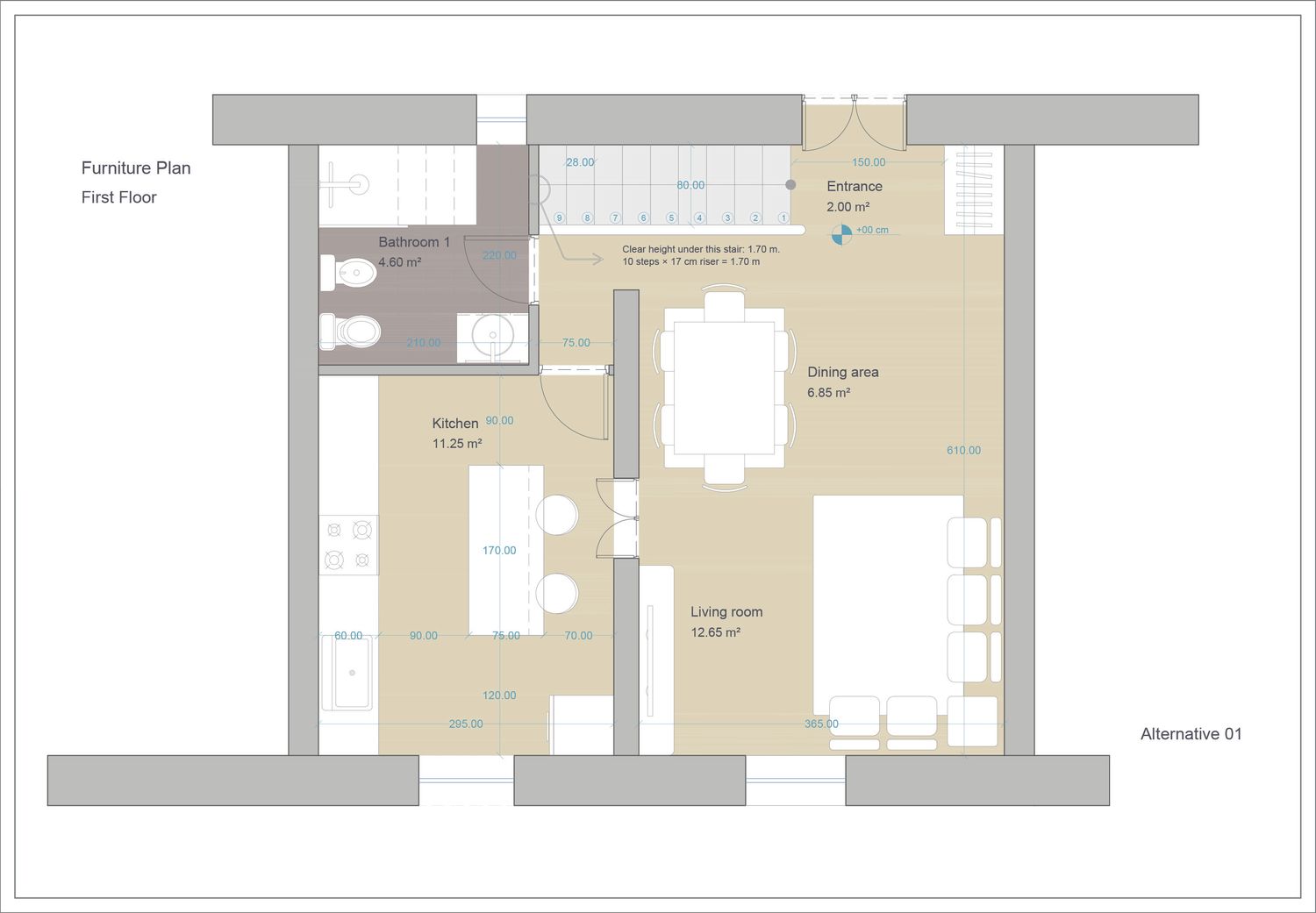
The entrance includes a wardrobe and shoe cabinet, and the stair access is also located in this area.
The staircase is a two-way stair with a landing, designed with a standard number of steps on each run so that the space beneath it can be used as a bathroom, as you requested. The bathroom begins under the tenth step. As shown on the plans, the height from the ground floor to the underside of the tenth step—considering a riser height of 17 cm—is 1.70 m. At the shower area, the landing is above, and the height from the floor to the underside of the landing is 2.55 m. These heights, even with a suspended ceiling, are acceptable for a bathroom and do not create headroom issues. Locating the bathroom here makes efficient use of the space under the stairs, provides a window, and keeps drainage works manageable given the position of the original bathroom.
On the upper floor, a small hall connects the spaces. Both the child’s room and the master bedroom have standard dimensions, and the master bedroom includes a walk-in closet. The laundry room and a windowed bathroom are also located on this level.
Considering the cost and risk of removing the central load-bearing wall to reorganize the layout, one of the options (Alternative 1) is designed without removing this wall. By removing the storage room and slightly shifting the bathroom, the kitchen gains more space. Two access points are provided, allowing you to either remove the door to the living room and keep only an opening, or replace the door with a glass one. The central island includes seating and provides both cabinetry and counter space, and standard kitchen clearances are respected. The dining area is placed between the kitchen and the living room.
In Alternative 1, the upper-floor laundry room acts as a transitional space before entering the bathroom. The master bedroom and its walk-in closet are larger than in the second alternative.
In Alternative 2, an opening is created in the load-bearing wall (the upper portion of the former door is kept, and a supporting column is placed at the bottom of the opening, close to the window wall, for better structural stability). This makes the kitchen larger and provides stronger visual and functional connection with the living area. The island is placed in this opening zone. The kitchen is fully open, without a door. A generously sized storage room is added within the kitchen; if you prefer, it can be removed to create an even larger kitchen. The dining area is positioned by the window, and the remaining portion of the load-bearing wall is used as a TV wall for the living room.
On the upper floor of this alternative, the hall is smaller. The laundry room is separate from the bathroom. The bathroom is very large but requires changes to the plumbing layout.
To give you a clearer understanding of the heights in each area, I placed elevation markers on the floor plans of each level and on the stair landing. In designing and calculating the stairs, I assumed 32 cm for the slab between the two levels.